TL;DR
- Lil Shine (Jasper William Johnson) was sentenced Monday, May 19, 2026, to 36 months in federal prison, according to a post on his verified Instagram account.
- Court filings reported by an underground news account on X two days before the hearing had indicated he was facing up to 3.5 years (42 months) and a $33,000 fine. The 36-month sentence came in below that exposure.
- The case stems from a December 2024 federal indictment charging Shine and two co-defendants with hacking the DEA's practitioners and physicians system, stealing physician credentials, and ordering roughly 300 pints of promethazine with codeine through fraudulent pharmaceutical wholesaler accounts. The alleged street value was around $750,000.
- The sentence comes four days after the May 15 release of Get Rich Or Die Sippin', his third studio album, which is currently the highest-rated project of his career.
- No major outlet has confirmed the sentence as of publication. The 36-month figure comes directly from Shine's own Instagram Story.
What he said
Lil Shine confirmed the sentence himself, posting to his verified Instagram account (@1lilshine) within an hour of leaving federal court in Minnesota. The post was two words on a black background: "36 months" and "lighttttt."
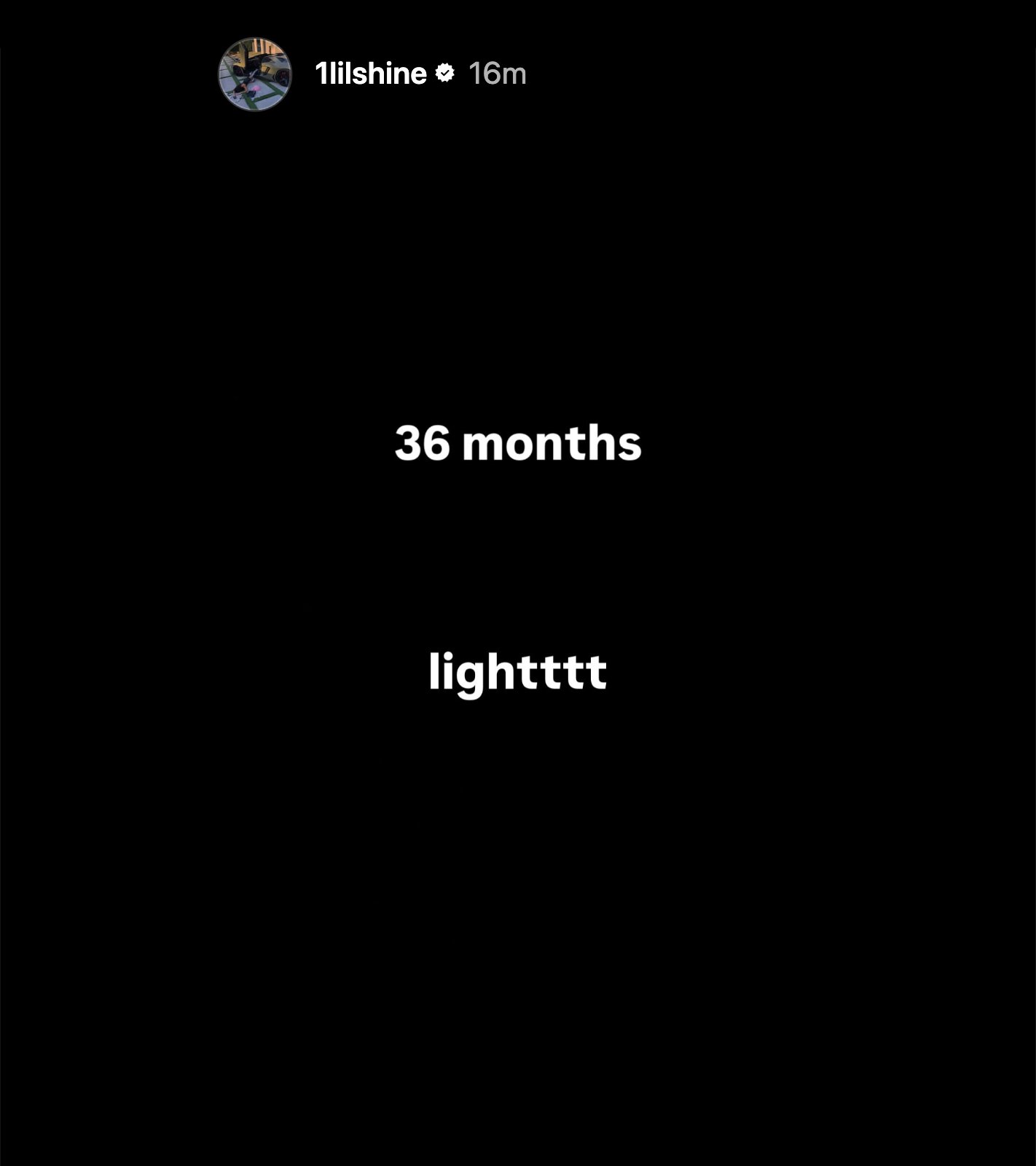
That is the entire public statement so far. No lawyer's statement, no label statement, no major outlet has confirmed the figure as of this writing. The 36-month number is from him, posted to his Story, and that is the source for this piece. Court records and reporting from HipHopDX, HotNewHipHop, and the Minnesota US Attorney's office are expected to follow in the coming days and will either confirm or revise the specifics.
The casual tone of the post tracks with the way Shine has handled the case publicly since the indictment broke in December 2024. He initially posted "IM INNOCENT!" on his Story before pivoting to an Instagram Live where he said he expected the charges, had received a target letter in the mail, and intended to keep dropping music while fighting the case from outside. He did. Shine Forever came out January 1, 2025. Get Rich Or Die Sippin' came out four days ago.
How we got here
The federal case has been public for almost a year and a half. According to the indictment first reported by HipHopDX in December 2024, Shine and co-defendants Oscar Becerra-Ruiz and Raujaun Keon Varner allegedly ran a scheme from December 2022 to August 2023 to infiltrate the Drug Enforcement Administration's practitioners and physicians database. They were accused of stealing physician credentials, opening fraudulent customer accounts with pharmaceutical wholesalers, and using those accounts to order at least 300 pints of promethazine with codeine, which were shipped to fake doctors' offices across the United States. The DEA stated at the time that no patient data was compromised in the breach. The street value of the drugs involved was put at roughly $750,000.
Shine was charged with conspiracy to acquire and obtain controlled substances by fraud, 11 counts of wire fraud, 3 counts of accessing a protected computer in furtherance of fraud, and 4 counts of aggravated identity theft. The wire fraud and aggravated identity theft counts carry mandatory minimums under federal law, which is the part Shine specifically flagged in his original Instagram Live response. ("A lot of my charges got mandatory minimums but it's early, I'm letting my lawyer handle that.")
Two days before the sentencing, the underground news account 42 (@42dailyy on X) posted that "new court documents show that Lil Shine is possibly facing 3.5 years imprisonment and a $33k fine." A 36-month sentence is six months below that exposure. We do not yet have public visibility into whether that reduction reflects a plea agreement, a downward departure granted at sentencing, or cooperation. That's the part to watch for in the coming days as legal coverage catches up.
“A 36-month sentence is six months below the exposure court filings were indicating two days before the hearing.”
What 36 months actually means
Federal sentences are served at roughly 85% with good time credit, meaning Shine is likely looking at approximately 30 to 31 months of actual incarceration if the standard calculation applies. He is 21 years old. He would be eligible for release some time in late 2028 or early 2029 under that math, depending on credits, the specific Bureau of Prisons facility, and any time already served or credited toward the sentence.
There is also no public information yet on a surrender date, the specific facility, or whether the sentence includes any term of supervised release, restitution, or the $33,000 fine the court documents had referenced. All of that should clarify in the days ahead.
The two co-defendants
Almost all of the public conversation around this case has focused on Shine because of his profile in the pluggnb scene, but he is one of three defendants. Oscar Becerra-Ruiz and Raujaun Keon Varner were charged in the same indictment. Their cases have moved largely outside of music press coverage, and we do not have confirmation here on whether they have been sentenced, what their exposure looked like, or how their cases were resolved. Worth tracking, since their outcomes are likely instructive for understanding what Shine's 36-month figure actually represents in the context of the full prosecution.
What happens to the music
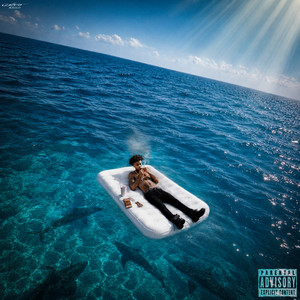
Get Rich Or Die Sippin' came out on May 15. As of last night, the album was sitting at a user score of 84 on Album of the Year with over 400 ratings logged, the highest of Shine's catalog by a meaningful margin. The rollout strategy was always built around the sentencing date, with the title, the cover, and the fan campaign all explicitly pointing at the loss of liberty that's now confirmed.
In practical terms: there will be no tour, no festival run, no in-person promo for this album. The work has to do its own promotional work for the next two and a half to three years. That puts a real test on the artist's existing audience and the platforms they listen on, because every stream, sale, and share for the next three years happens without the artist present to push it.
We published a full review of Get Rich Or Die Sippin' on May 15. Read that here.
Where things stand
This piece will update as legal coverage catches up. The headline figure of 36 months is direct from Shine's public account, which is the highest standard of source we have available right now and which we'd treat as reliable for an artist confirming his own sentence. The shape of the sentence (probation, supervised release, restitution, surrender date, designated facility) will all come out as the formal docket entries surface and as Bureau of Prisons information becomes public.
If you cover this story for another outlet and want the specific court documents referenced in our reporting, the indictment was filed in the District of Minnesota in December 2024 and the case names Becerra-Ruiz, Johnson, and Varner. The May 17 X post referencing the 3.5-year exposure pointed to court documents but did not link them publicly. We will update this article as primary documents become available.
The bigger question
A 21-year-old rapper from Minneapolis releases a well-reviewed album on Thursday, posts "36 months / lighttttt" on Monday, and disappears from the daily life of a scene he helped build. The music keeps streaming on services that pay tenths of a cent per play, owned by companies that have no relationship to the artist or his audience. Whatever income the album generates over the next three years will trickle through DSPs and distributors before any of it reaches Shine, his family, or a commissary account.
This is the part of the music economy that doesn't get discussed when people talk about streaming "fairness." When an artist can't be present to promote their own work, the platforms that own the listening relationship continue to extract their share, and the artist's ability to capture the value of their own catalog drops further. The structural incentives in this lane are not designed for an artist's worst week. They are designed for the platforms' best one.
That's why Signed Trade is being built differently. Buy music directly from artists, no label middlemen, no streaming-service skim. Every royalty split is public, every dollar from every stream and every sale traceable on an open ledger. Artists get paid instantly on every stream and every purchase, in real time, not on a quarterly delay that's especially punitive for incarcerated artists. Tracks have a market cap that moves with performance, so fans who keep an album alive while the artist can't promote it themselves can actually share in the upside they helped create.
The platform is not live yet. The waitlist is. If you've been watching this case and thinking about what the industry around it looks like, this is the moment to be early. Join at signed.trade.